

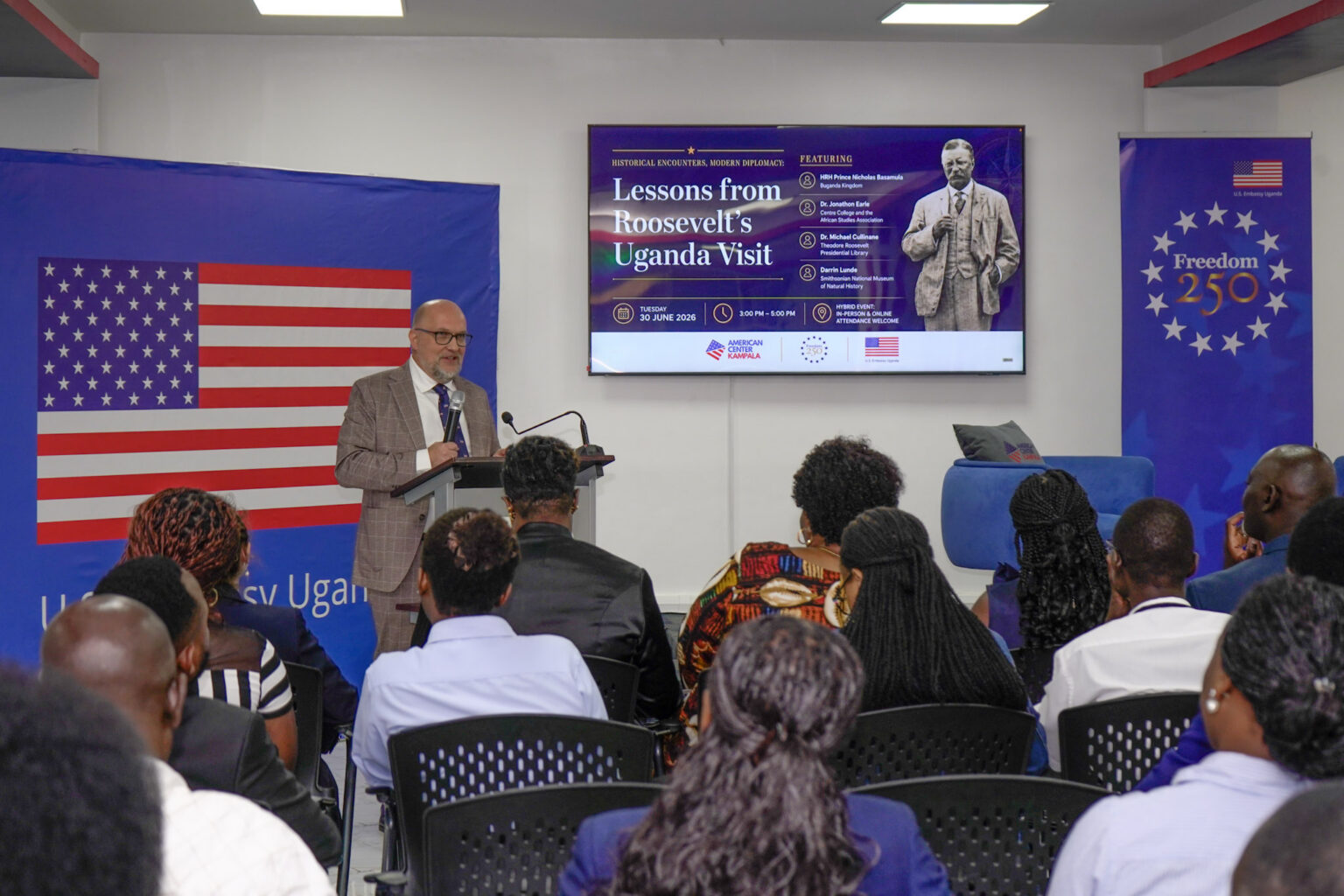
The American Center hosted a panel discussion bringing together scholars, scientists, and diplomats from Kampala, Kentucky, and the Smithsonian, along with members of the Buganda Kingdom, to explore a chapter of history that connects Uganda and the United States.
Immediately after leaving the White House in 1909, Theodore Roosevelt set out on one of the most storied expeditions of the twentieth century. In East Africa he encountered the Buganda and Bunyoro Kingdoms, the landscapes of the region, and the people who lived there. It was, in many ways, America's first act of public diplomacy in East Africa.
The conversation came as the United States marks 250 years since the Declaration of Independence. Roosevelt read that document as a set of living principles meant to be carried by ordinary citizens. Less than a year after leaving Uganda, he stood before an audience at the Sorbonne in Paris and delivered "Citizenship in a Republic," arguing that a democracy's strength rests not in its institutions alone but in the character of its people:
"The credit belongs to the man who is actually in the arena, whose face is marred by dust and sweat and blood; who strives valiantly… who at the best knows in the end the triumph of high achievement."
The panel featured Prince Nicholas Basamula of the Buganda Kingdom; Jonathan Earle of Centre College and the African Studies Association; Michael Cullinane of the Theodore Roosevelt Presidential Library; and Darrin Lunde of the Smithsonian National Museum of Natural History.
The event closed with thanks to the Ugandan government partners and agencies working to commemorate the expedition through the forthcoming Roosevelt Heritage Trail, and with a reminder of what Roosevelt believed the measure of a nation to be: a willingness to show up, engage, and build.
Quick links
Trail
Documentary
Agri Hub
News
Contact
social media